
“Despicable Betrayal”: Democrat Haley Stevens Stuns Party by Endorsing Republican Mike Rogers in High-Stakes Michigan Senate Race

With just hours to go before the crucial U.S. midterm elections, Michigan’s political landscape has been rocked by an unexpected and explosive cross-party endorsement.
Outgoing Democratic Congresswoman Haley Stevens dropped a massive political bombshell on Sunday, announcing that she is throwing her weight behind Republican candidate Mike Rogers for the U.S. Senate—spurning her own party’s official nominee, Abdul El-Sayed.
The stunning move has sent shockwaves through Washington and ignited a fierce civil war within the Democratic Party as control of Congress hangs in the balance [cite: “Democratic Party”, 1.1.1].
From Primary Bitter Rivals to an Unthinkable Cross-Party Turn
The roots of this extraordinary fallout trace back to a bruising Democratic primary in August, where El-Sayed narrowly defeated Stevens for the Senate nomination to replace retiring Democratic Senator Gary Peters [cite: “Abdul El-Sayed wins Michigan’s Democratic Senate primary in major victory for party’s progressive wing”, 1.2.5].
While Stevens initially pledged support for El-Sayed, deep ideological fractures—particularly concerning foreign policy, Israel, and campaign rhetoric—festered beneath the surface. Tensions reached a boiling point over the weekend when an independent left-wing political action group released a controversial advertisement linking U.S. aid for Israel to domestic economic struggles [cite: “Why did Democrat Haley Stevens just endorse a Republican for US Senate?”].
When Stevens demanded that El-Sayed explicitly condemn the ad, her demands were brushed aside, with El-Sayed accusing her of trying to re-litigate a primary that ended months ago [cite: “Why did Democrat Haley Stevens just endorse a Republican for US Senate?”].
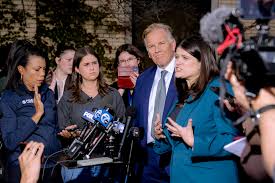
The climax arrived on Sunday when a planned joint appearance at a Detroit church service fell apart. Organizers and campaign figures uninvited Stevens, citing distractions [cite: “Why did Democrat Haley Stevens just endorse a Republican for US Senate?”]. Expressing outrage over being told she was no longer welcome, Stevens appeared side-by-side with Republican Mike Rogers at a separate church service to officially announce her defection [cite: 1.1.1, “Why did Democrat Haley Stevens just endorse a Republican for US Senate?”].
“Our Democratic nominee for Senate said I was no longer welcome in his campaign and that I should stay away,” Stevens said in a video statement [cite: “Why did Democrat Haley Stevens just endorse a Republican for US Senate?”]. “And he’s right. And that’s why I am endorsing Mike Rogers for the United States Senate today.”
“Despicable Betrayal” vs. “Bravery”: Inside the National Reaction
The backlash from Democratic leadership was swift, furious, and uncompromising.
- Chuck Schumer: Senate Democratic Leader Chuck Schumer didn’t mince words, publicly denouncing the move as a “despicable betrayal”.
- State Party Action: The Michigan Democratic Party moved swiftly to distance itself, with state party chair Curtis Hertel declaring that Stevens “is not a current member of the Michigan Democratic Party, nor will she be in the future”.
- Staff Resignations: The internal fallout was immediate; several long-standing members of Stevens’ congressional staff, including her chief of staff of eight years, resigned in protest [cite: “Why did Democrat Haley Stevens just endorse a Republican for US Senate?”].
On the flip side, the Republican camp celebrated the unprecedented endorsement. President Donald Trump took to social media to hail Stevens’ actions, calling it a display of rare “bravery”, while House Speaker Mike Johnson and other GOP leaders praised her bipartisan crossover [cite: “Why did Democrat Haley Stevens just endorse a Republican for US Senate?”].
What This Means for the Midterms
With Michigan sitting squarely as one of the pivotal battleground states that could determine which party controls the U.S. Senate, political analysts are scrambling to measure the fallout.
While El-Sayed’s camp maintains that their voter base remains heavily consolidated and focused on bread-and-butter economic issues like the cost of living [cite: 1.1.2, “Why did Democrat Haley Stevens just endorse a Republican for US Senate?”], opponents hope Stevens’ high-profile defection in suburban strongholds like Oakland County could sway moderate and independent voters [cite: “Why did Democrat Haley Stevens just endorse a Republican for US Senate?”].
As voters head to the polls on Tuesday, all eyes remain locked on Michigan to see how this dramatic eleventh-hour twist impacts the final tally.



 English