
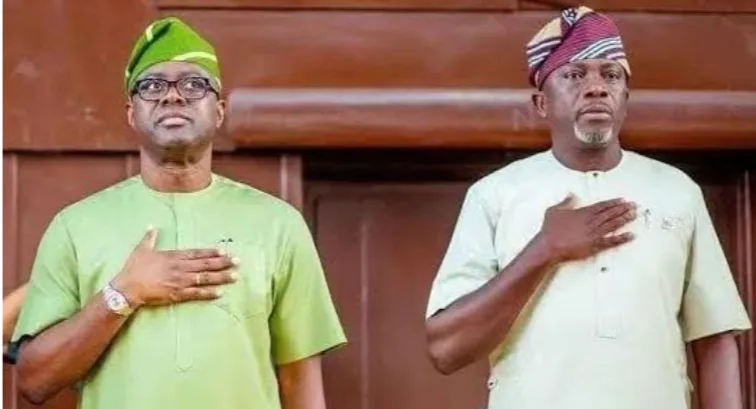

In what marks the most dramatic high-level exit from the Oyo State Government in recent memory, Hon. Segun Ogunwuyi, Chief of Staff to Governor Seyi Makinde, officially tendered his resignation on Monday, October 12, 2026.
In a succinctly drafted letter dated October 12, 2026, the former lawmaker confirmed that his resignation took effect immediately, ending a multi-year stint as the engine room of Makinde’s administrative hierarchy.
“I respectfully write to resign my appointment as Chief of Staff to the Governor of Oyo State, with effect from today, 12th October, 2026,” Ogunwuyi wrote. “Serving the Government and the good people of Oyo State has been a great honour. It has been deeply fulfilling to be part of the exceptional team that has worked relentlessly to deliver the remarkable achievements of this administration.”
While Ogunwuyi’s public statement maintains a polished tone of gratitude and loyalty, investigative digging behind the scenes at Agodi Secretariat reveals a complex web of political realignment, growing administrative friction, and the quiet exodus sweeping through Governor Makinde’s inner circle.
1. The Growing Wave of High-Profile Resignations
Ogunwuyi’s departure is not an isolated event. Over the past two months, Governor Makinde has witnessed a quiet wave of resignations across senior aides, cabinet members, and political strategists.
Insiders reveal that the administrative discipline that defined Makinde’s early term has increasingly fragmented under the weight of national political calculations. As key lieutenants step aside one after another, Ogunwuyi’s exit represents the clearest signal yet of structural fatigue within the state’s executive council.
2. 2027 Calculations and Strategic Political Realignment
As an experienced political player who previously served in both the Oyo State House of Assembly and the House of Representatives representing Ogbomoso North/South/Orire Federal Constituency, Ogunwuyi understands political timing.
Political observers point to Makinde’s widening national ambitions—particularly surrounding political realignments and party structures ahead of the 2027 general elections—as a key catalyst for friction.
For months, whispers within political circles suggested that Ogunwuyi’s enthusiasm for Makinde’s national machinery had noticeably cooled. Rather than remaining tied to an increasingly strained administrative apparatus, Ogunwuyi’s resignation allows him to protect his political capital, solidify his base in Ogbomoso, and reposition himself ahead of the upcoming electoral cycle.
3. Friction Within the Agodi Inner Circle
Beyond electoral politics, administrative tensions inside the Secretariat had been mounting for months. Sources familiar with internal state house dynamics indicate that Ogunwuyi’s role as Chief of Staff—traditionally the primary gatekeeper to the Governor—had become increasingly complicated by competing political interests and parallel advisory structures.
When a Chief of Staff finds their operational leverage gradually circumscribed while remaining accountable for administrative friction, an exit becomes inevitable. Rather than allowing public fallouts to escalate, Ogunwuyi chose a strategic, calculated exit.
What Comes Next for Oyo State?
Segun Ogunwuyi’s sudden exit leaves a critical void at the center of Makinde’s administration at a time when political tensions across the South-West are mounting.
Whether Governor Makinde moves quickly to appoint an insider to steady the administrative ship or restructures his executive team entirely, Ogunwuyi’s departure confirms that the battlelines for Oyo State’s political future—and the 2027 contest—are already being drawn.


 English