

The race to construct the physical backbone of the artificial intelligence revolution has reached unprecedented financial scale. The world’s primary cloud hyperscalers—Amazon, Alphabet, and Microsoft—are collectively pushing their 2026 capital expenditure (capex) projections toward a staggering $595 billion.
Despite record commitments over the past several quarters, all three tech titans report that enterprise demand for cloud computing and generative AI workloads continues to outpace available supply.
Breaking Down the 2026 Capex Commitments
While individual accounting treatments for infrastructure leases vary across companies, the sheer scale of investment highlights a shared priority: building data centers, securing power grids, and expanding high-performance compute clusters as fast as supply chains allow.
| Hyperscaler | Updated 2026 Capex Estimate | Core Investment Allocation |
| Amazon | ~$220 Billion | AWS capacity expansion, custom AI silicon (Trainium & Inferentia), high-voltage power infrastructure |
| Alphabet | ~$195 – $205 Billion | Google Cloud data center scale, custom TPU hardware acceleration, enterprise Gemini API serving |
| Microsoft | ~$175 Billion | Azure AI infrastructure, global footprint expansion, hardware compute backlog fulfillment |
Why Cloud Giants Are Accelerating Capex
The record-breaking capital allocations reflect structural industry shifts rather than speculative overhead:
- Persistent Capacity Bottlenecks: Cloud providers are operating near 100% compute utilization. Amazon CEO Andy Jassy highlighted that capacity constraints for AI workloads are expected to persist well through 2026 and into 2027.
- Escalating Input Costs: Surging prices for high-bandwidth memory (HBM), advanced GPU allocations, liquid cooling systems, and specialized high-voltage energy grids have increased the deployment cost per gigawatt across new facilities.
- Strong Cloud Revenue Conversion: Far from being unmonetized experiments, enterprise adoption of generative AI continues to directly accelerate underlying cloud revenues. Microsoft, Google Cloud, and AWS have all reported accelerated growth driven by AI enterprise integrations.
Supply Chain Beneficiaries
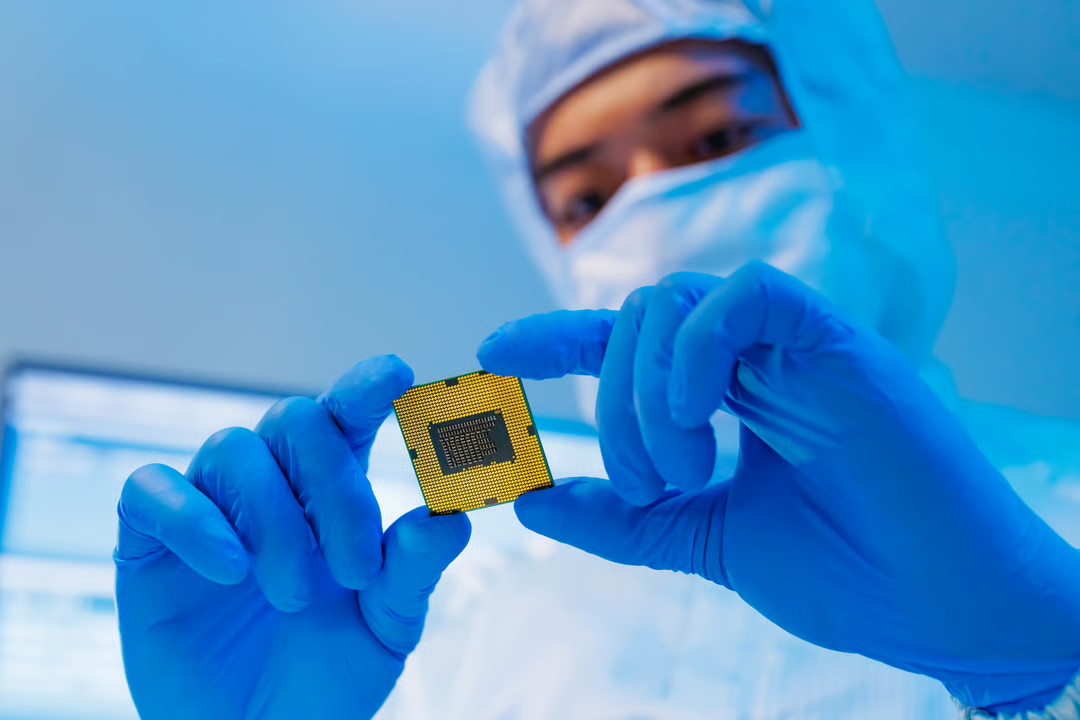
The influx of capital spending is creating a powerful tailwind for hardware suppliers, semiconductor foundries, and infrastructure vendors. Primary beneficiaries of this $595 billion outlay include semiconductor leaders NVIDIA and TSMC, alongside hardware power, cooling, and memory suppliers positioned upstream in the AI supply chain.



 English